The VW T7 Transporter eHybrid – Is This the Next Step for Campervan Conversions?
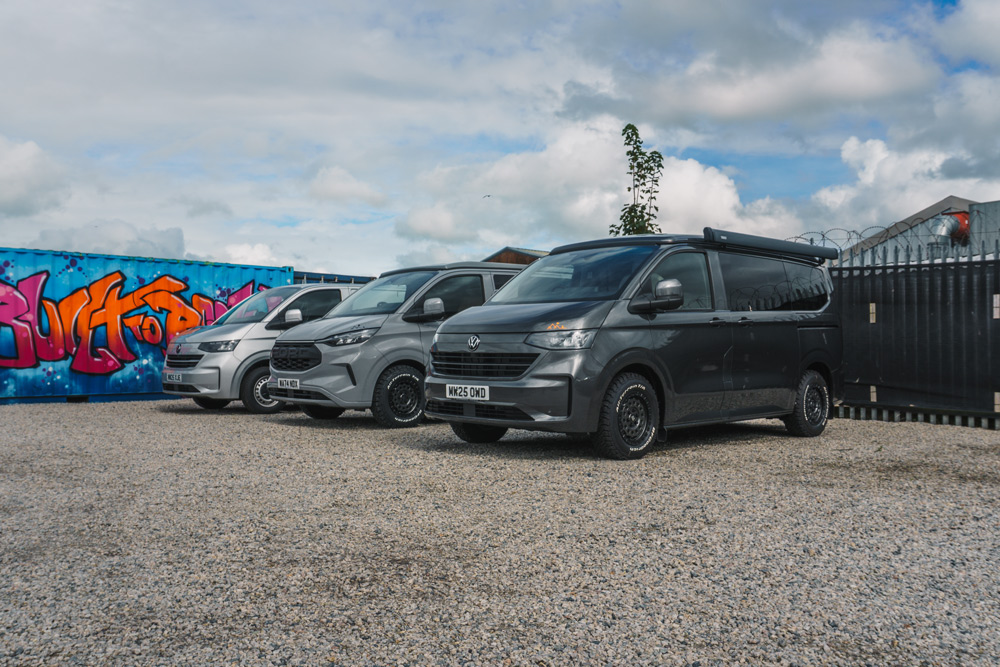
Volkswagen has opened UK orders for the plug-in hybrid Transporter. We look at what the eHybrid could mean for campervan conversions, how it compares to the diesel T7, and where it might fit alongside going fully electric.
The VW T7 Transporter eHybrid – Is This the Next Step for Campervan Conversions?
The Volkswagen T7 Transporter has quickly become an important part of what we do here at Taylored Campervans.
Since introducing our Offtrail conversion, we’ve been really impressed with the new Transporter platform. It’s comfortable, refined, great to drive and, most importantly for us, gives us a fantastic base from which to build a proper campervan.
Until now, our focus has predominantly been on the diesel T7 – and for good reason.
Diesel still makes a huge amount of sense in a campervan. It offers excellent range, good fuel economy on longer journeys and the convenience of being able to refuel almost anywhere in a matter of minutes. For customers planning big European trips or covering lots of motorway miles, we certainly don’t see diesel disappearing from our builds any time soon.
But there is now another option that we think could be particularly interesting for campervan owners.
The Volkswagen Transporter eHybrid.
What is the T7 eHybrid?
Volkswagen has now introduced a plug-in hybrid version of the new Transporter, combining a 2.5-litre TSI petrol engine with an electric motor, producing a combined 232 PS.
Rather than relying entirely on electric power, the plug-in hybrid combines electric driving with the flexibility of a conventional petrol engine.
For us, this is potentially a very good fit for a campervan.
You could complete shorter everyday journeys using electric power, charge the van at home where possible, but still have the freedom to jump in and head across the UK – or across Europe – without planning your trip around charging stops.
That combination is what makes the hybrid particularly interesting.
Why Choose Hybrid Over Diesel?
We don’t think this is necessarily a case of hybrid being better than diesel.
It’s about having another choice.
For a customer regularly covering hundreds of motorway miles, a diesel T7 remains an excellent option. Modern diesel engines are incredibly capable, economical on longer journeys and perfectly suited to the sort of touring many of our customers use their campervans for.
However, campervans aren’t always being driven hundreds of miles.
For many owners, the van is also their everyday vehicle.
School runs, commuting, shopping, trips to the beach and weekends away can mean lots of relatively short journeys between the bigger adventures.
That’s where the eHybrid starts to make a lot of sense.
Being able to use electric power for those shorter journeys while retaining a petrol engine for longer trips could offer a really useful middle ground between a conventional diesel campervan and going fully electric.
What About a Fully Electric Campervan?
We’re watching fully electric vans very closely too.
The new e-Transporter is already capable of an official combined WLTP range of up to around 225 miles, and that technology is only going to improve.
But converting an electric van into a campervan introduces another consideration: what happens to that range once you load it with everything required for a full camper conversion?
Furniture, a bed, pop-top roof, water, batteries, passengers, bikes and camping equipment all add weight.
For some customers, particularly those travelling long distances through Europe, the flexibility of a hybrid may therefore be a more natural stepping stone towards electrification.
You get the benefits of electric driving when it suits you without losing the freedom traditionally associated with a petrol or diesel campervan.
Will the Taylored Conversion Need to Change?
From what we’ve seen so far, we don’t expect the fundamental concept of our conversion to change significantly.
The T7 Transporter platform is already something we’ve spent a considerable amount of time developing around, and our current Offtrail layout has been designed specifically for the new generation Transporter.
Our approach would remain the same: maximise usable space, keep the conversion practical, use high-quality components and build a campervan that works just as well for everyday life as it does for travelling.
There will obviously be some technical differences underneath the vehicle due to the hybrid drivetrain and battery system, and these are areas we will assess carefully before completing our first customer conversions.
As with any new base vehicle, we won’t simply assume that something can be installed in the same position because that’s where we’ve always fitted it.
We’ll work around the vehicle.
What About the Campervan’s Electrical System?
One of the questions we’re already thinking about is how the hybrid drivetrain will integrate with the campervan’s independent leisure electrical system.
Our current Offtrail builds use dedicated off-grid power systems to run the equipment inside the campervan, including induction cooking and other 230V appliances.
Our intention with the hybrid would be to retain that philosophy.
The vehicle’s hybrid battery is there to drive the vehicle; the camper’s leisure system is there to power the campervan.
Keeping those systems clearly defined gives us much greater control over the conversion and means the camping side of the vehicle isn’t dependent on how much charge remains in the drivetrain battery.
Exactly how charging from the vehicle will be managed is something we’ll validate properly once we have the eHybrid in our workshop.
Diesel Isn’t Going Anywhere Yet
It’s easy to look at new technology and assume that everything before it has suddenly become outdated.
We don’t think that’s the case here.
For many campervan owners, diesel could still be the best choice.
If you’re regularly travelling long distances, touring Europe or simply want maximum range with minimum planning, the diesel T7 remains a brilliant base vehicle.
The eHybrid simply introduces another option.
And for someone who uses their campervan as an everyday vehicle during the week but still wants to disappear across Europe for three weeks in the summer, it could potentially be the sweet spot.
When Will We Build One?
This is the exciting part.
Volkswagen Commercial Vehicles has now made the Transporter eHybrid available to order in the UK, so we’re actively looking at when we can bring one into Taylored and put the platform through our own development process.
Before we offer an eHybrid conversion to customers, we’ll want to understand the vehicle properly.
That means looking at everything from the location of the hybrid components and available space underneath the vehicle through to weight, charging behaviour and how our existing electrical and heating systems integrate with the new drivetrain.
If we’re happy with it, we see no reason why the eHybrid couldn’t sit alongside the diesel T7 as another base vehicle option for the Taylored Offtrail.
The Next Generation of Campervans
Campervans have changed enormously over the last few years.
We’ve already moved towards increasingly powerful lithium leisure systems, solar, induction cooking and completely gas-free conversions.
The base vehicles are now beginning to go through the same transition.
For us, the important thing isn’t adopting new technology simply because it’s new.
It’s choosing technology that actually makes a campervan better to own and better to travel in.
The diesel T7 already gives us an excellent platform.
The eHybrid could give customers another way to enjoy exactly the same Taylored campervan – with electric driving for shorter journeys and the reassurance of an engine when it’s time to go further.
And that’s something we’re very interested in exploring.
Built to Roam.